
Recommended News
Hot News
Fill in your information
Industrial Self-Retracting Fall Arrest Devices & SRL Fall Protection Solutions
Industrial work at height does not tolerate ambiguity. A modern fall arrest device must protect people, support real jobsite movement, and fit into auditable industrial fall arrest systems and devices.
If you are comparing multiple fall arrest devices, start here:
- You need hands-free mobility with minimal slack during frequent repositioning: prioritize a self-retracting fall arrest device (SRL).
- You need a compact, harness-mounted solution for confined movement: evaluate SRL-P.
- You must align fall protection with rescue planning and potential post-fall retrieval: consider SRL rescue / retrieval-capable SRL concepts.
- You require lateral travel across a work zone (roofs, long platforms, bridges): assess horizontal SRL or SRL integration into horizontal systems.
- You are comparing older styles (e.g., rope grabs) versus retractables: treat rope grab fall arrest device options as a different category and evaluate them by task profile, access method, and training requirements.

What Is a Self-Retracting Fall Arrest Device (SRL)?
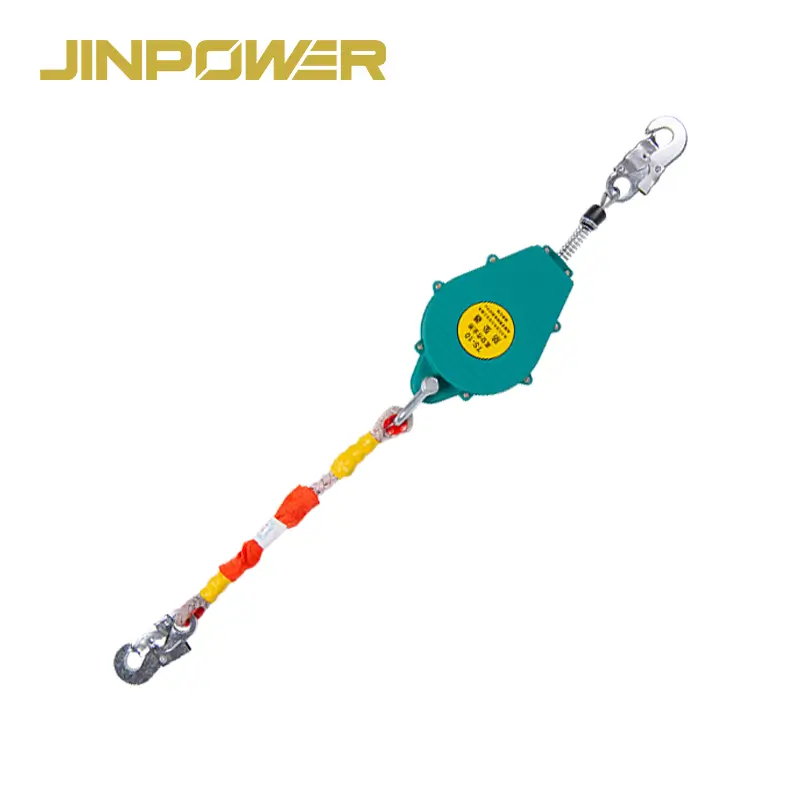
A self-retracting fall arrest device—also commonly searched as self retracting fall arrester, self retractable fall arrester, or self-retracting lifeline (SRL)—is a retractable lifeline that extends and retracts with the worker’s movement and locks rapidly during a fall event to arrest the fall. For many jobsite workflows, SRLs reduce slack management burden and support more natural movement compared with fixed-length connectors.
A fall arrest device is equipment intended to stop a fall after it begins, typically used as part of a personal fall arrest system (PFAS) that includes a full-body harness and a suitable anchorage/connector approach. In procurement terms, a fall arrester device is not “one item”; it is a risk-control component that must align with:
- job geometry
- clearance
- worker mobility needs
- local compliance expectations
How SRL Fall Protection Works
An SRL uses an internal mechanism that lets the lifeline retract smoothly during normal movement and locks during a fall to arrest the event quickly.
In plain terms, SRLs manage two different behaviors:
- Controlled extension/retraction: The line pays out and retracts as the worker moves, helping keep the line managed.
- Rapid locking under fall conditions: During a fall, the internal locking/braking mechanism is designed to engage quickly, reducing fall distance and helping manage arrest forces within the system’s labeled performance expectations.
A correct SRL selection always considers free fall distance and overall clearance. Even the best hardware cannot substitute for a correct system design that fits the work geometry and anchorage strategy.
SRL Product Types
Standard SRL (Self-Retracting Lifeline)
Standard SRLs are typically used with overhead anchorage for vertical applications. They are widely adopted in construction, maintenance shutdowns, utilities, towers, and general industrial access work. Standard SRL procurement usually focuses on:
- jobsite durability expectations,
- line material suitability for the environment,
- and compatibility with the site’s PFAS documentation.
SRL-P (Personal SRL)
SRL-P refers to a compact, personal SRL category commonly intended for harness-mounted use.
Buyers evaluate SRL-P when they need a solution that is:
- more compact for tight work zones,
- less cumbersome for frequent movement,
- and aligned with the organization’s classification language (often referenced in ANSI contexts).
If your workforce frequently transitions between ladders, platforms, and confined access points, SRL-P is often part of the shortlist because it can simplify day-to-day handling compared with larger housings—subject to local rules and the product’s labeled application scope.
SRL Rescue / Retrieval-Capable SRL
SRL rescue options are used when the safety plan requires retrieval capability after a fall.
Industrial buyers include SRL rescue solutions when they must demonstrate a stronger rescue posture—especially in remote structures, towers, or high-risk environments where prompt retrieval planning is a procurement requirement. This is not a “nice to have” feature; for many organizations it is driven by internal HSE policy and contract language.
Horizontal SRL and System Integration
Horizontal SRL use is typically discussed as part of system design for lateral movement across a work area.
Many buyers search “horizontal SRL” to solve a practical problem: the job requires side-to-side movement across a long edge, platform, or roof zone. In practice, this is addressed through industrial fall arrest systems and devices architecture that supports the needed travel path, clearance, and anchorage plan—rather than treating “horizontal SRL” as a simple add-on.
SRL vs. Rope Grab Fall Arrest Device
SRLs and rope grab fall arrest device solutions serve different access patterns; SRLs emphasize retractable movement with rapid locking, while rope grabs are a different style of device used on a lifeline with distinct handling and training considerations.
Buyers often compare these categories during early scoping:
- Choose SRL fall arrest when mobility and slack management are central to the task workflow.
- Consider rope grab solutions when the job is structured around a fixed lifeline approach and the crew’s access method aligns with that system’s operational realities.
To prevent mis-buying, align the device category with the actual work method statement and training program—then validate with local compliance requirements and your internal safety standards.
Industrial Fall Arrest Systems and Devices
A strong procurement decision treats SRLs as part of a system, not a standalone SKU. At a minimum, a complete industrial approach typically includes:
- a suitable full-body harness strategy,
- compatible connectors,
- an anchorage plan that matches job geometry,
- and documented inspection/retirement controls consistent with your safety program and local requirements.
This system view is exactly why buyers search the broader phrase industrial fall arrest systems and devices—they want fewer compatibility issues, cleaner compliance documentation, and a repeatable standard across sites and contractors.
Where SRL Fall Protection Is Commonly Deployed
Utilities, Substations, and Power Maintenance
Utilities and industrial electrical environments often involve repeated repositioning, climbing, and task-based movement. SRL fall protection is commonly evaluated to support mobility while maintaining a managed lifeline condition.
Telecom and Tower Work
Tower workflows emphasize vertical movement and frequent work positioning transitions. SRLs and SRL-P options appear frequently in buyer shortlists due to compact handling considerations and jobsite practicality—subject to the site’s compliance framework.
Construction and Structural Installation
In construction, work patterns can change daily. Buyers typically prioritize fall arrest devices that are easy to deploy consistently across crews and subcontractors, while still supporting auditable compliance documentation.
Industrial Plants, Maintenance Shutdowns, and Confined Access Zones
Maintenance turnarounds and industrial access often involve constrained movement paths and mixed teams. SRL-P and compact SRL concepts can reduce operational friction, while rescue planning can drive SRL rescue requirements in higher-risk zones.
Buyer Selection Criteria That Improve Outcomes
If you are sourcing globally without model-level parameters yet, you can still build a strong selection framework:
1) Work Geometry and Anchorage Strategy
The anchorage location and the worker’s travel path are decision drivers. SRL fall protection that performs well in one geometry may not be appropriate in another. This is the first filter your HSE and engineering stakeholders should agree on.
2) Clearance and Free Fall Considerations
Fall arrest devices must be chosen in a way that matches available clearance. Free fall distance and total fall clearance concepts are central in fall protection guidance and regulations, and they influence device selection discussions in procurement.
3) Environment and Durability Expectations
Material choice, housing durability, and environmental suitability matter in global industrial contexts—especially where humidity, dust, corrosion risk, or harsh temperatures are common. These conditions should be explicitly stated in RFQs so suppliers can propose the correct SRL category and construction approach.
4) Compliance Documentation and Traceability
B2B buyers typically require:
- standard references in documentation,
- clear labeling and identification for asset tracking,
- and a documentation pack aligned to local compliance needs and internal audit requirements.
Standards and Compliance Context for Global Procurement
For global industrial sourcing, buyers commonly reference recognized fall protection frameworks:
- OSHA requirements in the U.S. describe expectations for PFAS components and performance considerations.
- ANSI Z359.14 is a key SRL reference standard in many procurement conversations, including SRL category language such as SRL-P and rescue-capable concepts.
Final selection and use should always follow local regulations and the product’s official instructions and labeling, supported by competent safety management.
Documentation and Quality Expectations
A credible supplier of fall arrest devices should be able to support buyer due diligence with:
- consistent product identification and labeling strategy,
- compliance-aligned documentation appropriate to the target market,
- and a clear approach to traceability for fleet management and audits.
For B2B procurement teams, this documentation readiness is often as important as the hardware itself—because it reduces project risk, audit friction, and rollout delays.
FAQ
Contact us
If you are sourcing for multiple projects or countries, standardize your procurement language around self-retracting fall arrest devices, SRL fall protection, and industrial fall arrest systems and devices. Share your typical industries and work geometry (overhead anchorage, lateral movement zones, rescue expectations), and you can build a cleaner shortlist that fits compliance and real jobsite needs.






 Hrvatski
 Čeština
 Dansk
Dansk Nederlands
 Filipino
 Français
 Deutsch
 Italiano
 日本語
日本語 Қазақ тілі
 ភាសាខ្មែរ
 한국어
한국어 Кыргызча
 ພາສາລາວ
 Монгол
 فارسی
فارسی Polski
 Português
 Română
 Русский
 Slovenščina
 Español
 Kiswahili
 ไทย
ไทย Українська
 Tiếng Việt
 English